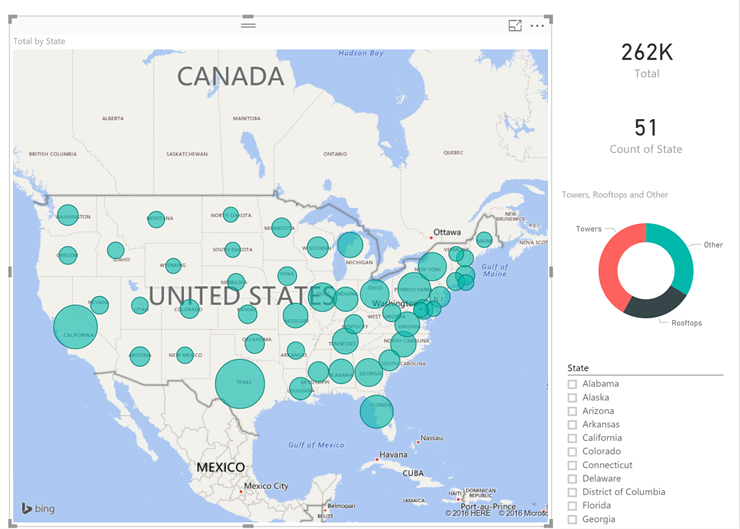
There are approximately 260,000 cell tower sites across the US. The below chart depicts the number of cell towers per states. Interestingly, there are more cell sites in Texas than in California while California has about 12 million more populations. The carriers are maintaining and upgrading the cell sites to meet the demand of the mobile users. This cell site management is one of the largest business sectors in the Telecommunications industry.
We wanted to know if the graph database could be a help of the project management in the Network upgrade process. Let us show you how it worked.
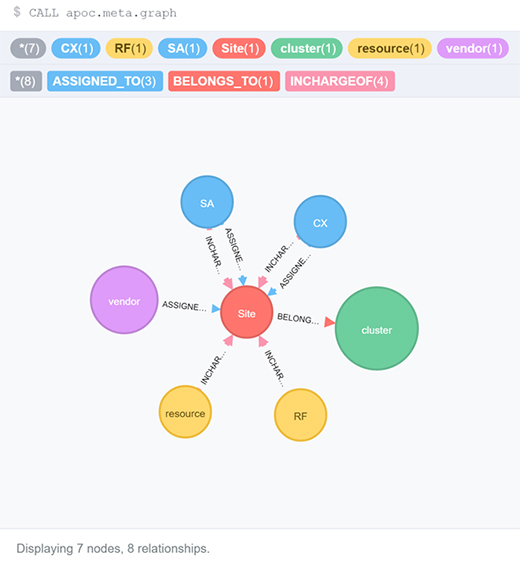
We implemented the cell site information into Graph DB. We created nodes for the internal resources, the vendors, the cell sites and the clusters. And then we also created relationships between nodes such as ‘BELONGS_TO’, ‘ASSIGNED_TO’, and ‘INCHARGEOF’. In this example, we used CQL, the Cypher Query Language. The below image shows the meta graph of the data implemented.
Let’s see what we found. Just for your reference, all the names are randomly generated, and this example does not reflect the actual businesses.
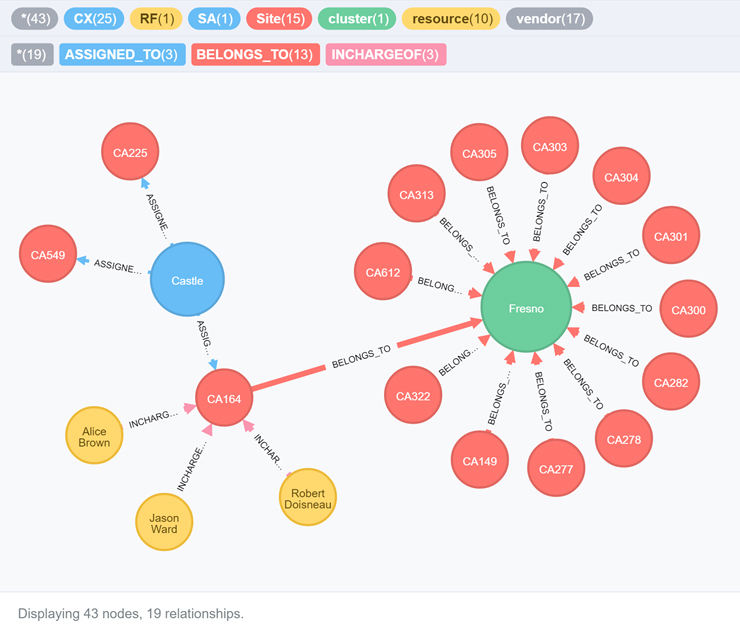
In this example, one of the construction managers reported that a vendor named ‘Castle’ is underperforming. Especially due to the delay of the site id ‘CA164’, the entire schedule of ‘Fresno Cluster’ launching might be affected.
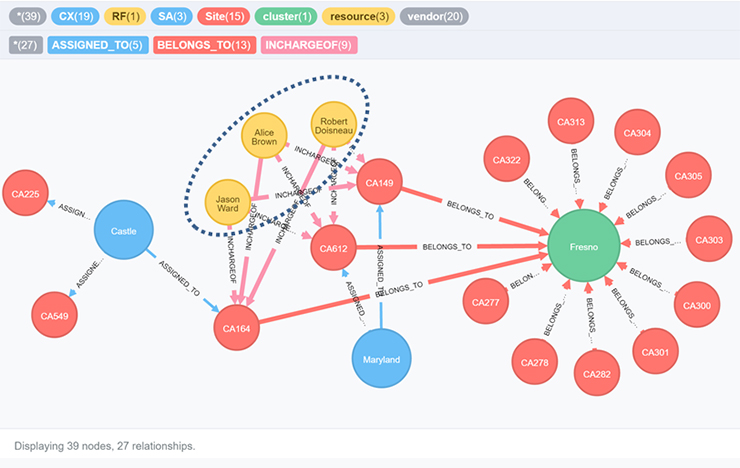
So we had to look up the other sites which belong to this cluster and see if the vendors who are assigned to those sites have enough crew to handle this matter. Our first approach was relatively intuitive. We could see ‘CA612’ and ‘CA149’ are assigned to ‘Maryland’ who has indicated good performance so far. And one more thing we found is that both sites are under the management of the same internal resource group. That implies there will be a less hectic period when it is transferred to another vendor.
Today we tried to see if Graph DB can be used as a project management tool. As a first step, we implemented the project data into Graph Database. In the next posting of this series, we will translate the above request into a query language. And then we will refine the queries further to get more sophisticated results.
Common questions
Do I need a dedicated graph database for a small project tracker?
No. For a handful of tasks and shallow dependencies, a relational database with recursive queries or even an in-memory structure is simpler to operate. Graph databases pay off once dependency chains get deep or you need frequent multi-hop traversal queries.
Can I implement project data as a graph inside PostgreSQL instead of a separate database?
Yes, either with recursive common table expressions for shallow, fixed-depth dependency checks, or with an extension such as Apache AGE, which adds openCypher graph querying on top of PostgreSQL tables. This avoids running a second database system for graph-shaped project queries.
How do I handle circular dependencies between tasks?
Detect them during import, not during query time. Run a cycle-detection traversal (or a Cypher query that checks whether a DEPENDS_ON path leads back to its own starting node) before accepting new data, since a real dependency graph should be a directed acyclic graph.
What is the best format for importing project data from a project management tool export?
CSV or JSON with a stable unique identifier for each entity works well, since most graph databases provide bulk loaders that expect flat files mapped to node and relationship creation rules. Avoid matching on display names, which change and are rarely unique.
Should relationship properties like assignment percentage live on the node or the edge?
On the edge. A fact that describes the relationship between two entities, such as how much of a task a person is assigned to, changes per relationship and does not belong on either endpoint node.
Sources
About this page
Last reviewed October 30, 2026 by the Nine Bits editors. Read our editorial policy or report an error.