Recommendation Engine performed a role that connects people to products, services, and information through analysis among their relationship, offer optimal result at the rapid time. Key point for its task is to offer faster and real-time recommendation to people what people want by system. So companies get more profit. Recommendation Engine is a kind of graph data important definition and analysis social connections or connecting the dots between seemingly unrelated facts to infer interests. And the strength is faster and computable through available process directly.
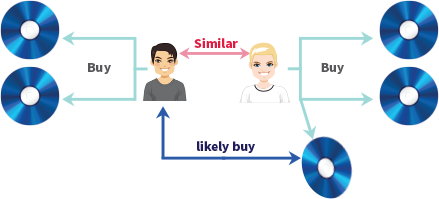
What is the application plan of Graph Database?
Graph databases have revolutionized the way people discover new products, services, information and people. Recommendation engines powered by graph databases help companies to personalize products, contents and services by leveraging the connections between data — all in real time and connect people to products, services, information or other people based on user profile, preferences and past online activity such as product purchases. Graph databases also enable users to search for products, services or people based on a host of fine-grained criteria and continually improve recommendations by accommodating new data sources and types.
So, how does it implement?
A simple way is each product assuming that a Node, when customer bought product2 who also bought product1, make relationship among product1 to product2 with improve weight. Afterward, graph database can be used when some people want to buy same product, the way offer real-time recommend heavy weight’s product top 5 related to this product in graph database.
Common questions
Is a graph database always faster than SQL for recommendations?
No. For shallow, fixed-shape queries like same-category lookups, a well-indexed relational table is usually simpler and just as fast. Graph traversal pays off once queries need multiple hops or variable-length paths that would otherwise require stacked self-joins.
What query language do graph recommendation engines use?
Cypher and the related open specification openCypher are the most common, along with Gremlin. Both let a query describe a relationship pattern to match rather than a join to compute.
Can I add graph queries to a PostgreSQL database I already run?
Yes. Apache AGE is an open-source PostgreSQL extension that adds a graph data type and openCypher support, so graph traversal queries can run in the same database as existing relational tables. Check the project's current release notes for supported PostgreSQL versions before installing it.
Does a graph database replace machine learning in a recommendation system?
No. A graph database is typically used to find and narrow down relevant candidates through relationships. Ranking those candidates by predicted relevance is usually handled by a separate scoring or machine learning step.
How do graph-based engines handle new users with no purchase history?
They generally do not solve cold start on their own, since a new user has few or no edges to traverse. Systems typically fall back to popularity-based or content-based recommendations until enough interaction data exists.
Does more data make a graph database necessary?
Not by itself. Row count alone rarely forces the choice. What matters is whether typical queries need to walk multiple relationship hops; a large table queried one hop at a time is still a good fit for plain SQL.
Sources
About this page
Last reviewed October 30, 2026 by the Nine Bits editors. Read our editorial policy or report an error.